
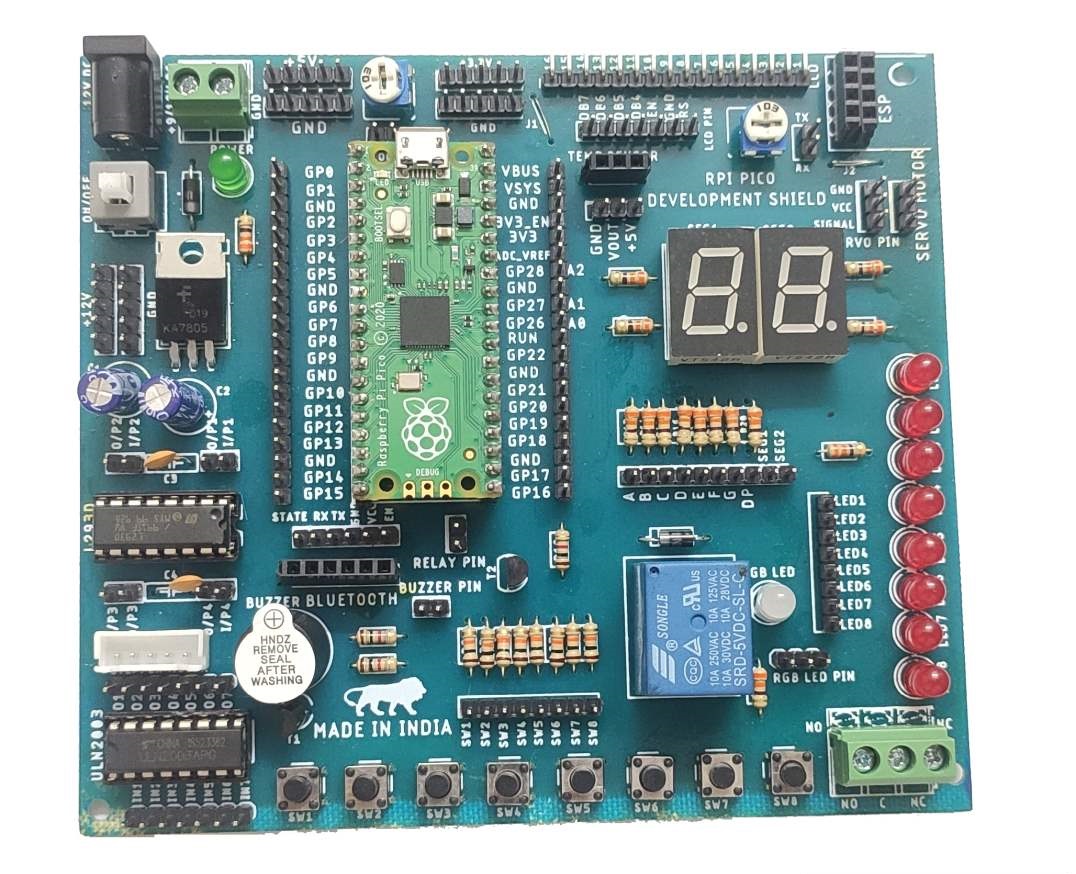
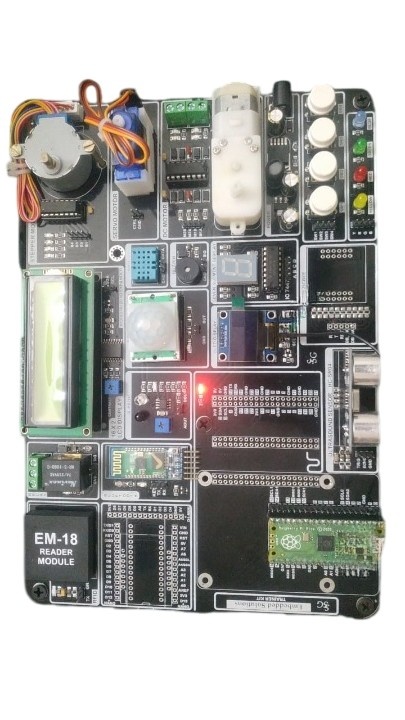
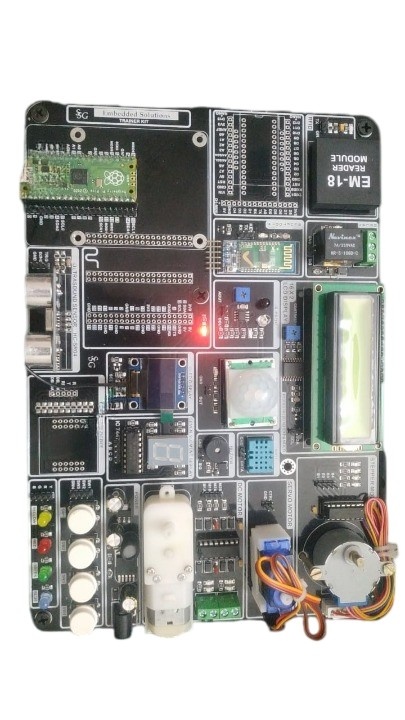
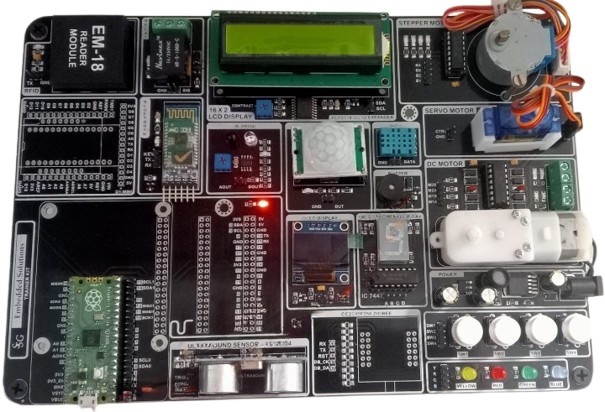
Raspberry Pi Pico Development Board
The Raspberry Pi Pico Development Board is a compact microcontroller development platform powered by the RP2040 chip developed by Raspberry Pi. It features a dual-core Arm Cortex-M0+ processor with a flexible clock speed of up to 133 MHz, making it suitable for embedded systems, IoT, robotics, automation, electronics applications, learning, and rapid prototyping.
https://ssges.co.in/wp-content/uploads/2025/13/Raspberry%20pi4B%20Programm.zip
The board supports both C/C++ and MicroPython, providing flexibility for beginners, students, educators, hobbyists, and experienced developers. Its compact design, multifunctional GPIO pins, built-in USB programming capability, and multiple communication interfaces make it suitable for developing and testing a wide range of hardware projects.
RP2040 Hardware Specifications
- Microcontroller: RP2040 32-bit microcontroller
- Processor: Dual-core Arm Cortex-M0+
- Clock Speed: Up to 133 MHz
- SRAM: 264 KB
- Flash Storage: 2 MB
- GPIO: 26 multifunctional GPIO pins
- ADC: 3 × 12-bit ADC
- PWM: 16 controllable PWM channels
- Communication: 2 × SPI, 2 × I2C, 2 × UART
- USB: Built-in USB programmer
- Supply Voltage: 3.3V
- Power: Ultra-low-power sleep modes
Microcontroller Learning and Development
The board provides an excellent platform for exploring microcontroller programming and hardware interfacing. With support for C/C++ and MicroPython, users can develop applications involving sensors, displays, motors, communication modules, and other electronic components.
Its GPIO and peripheral capabilities allow users to experiment with digital and analog inputs, PWM-based control, serial communication, and sensor interfacing. The RP2040 also includes programmable I/O capabilities that can be useful for specialized hardware interfaces and advanced embedded applications.
Kit Contents
The kit includes:
- Raspberry Pi Pico Development Board
- CD containing required software, manuals, and sample programs
- Assembly and C sample programs
- Cables and connectors
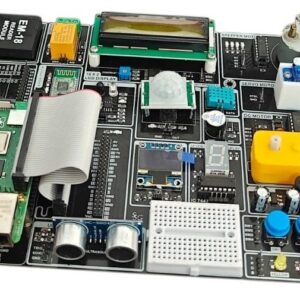
Peripheral Interfaces and Modules
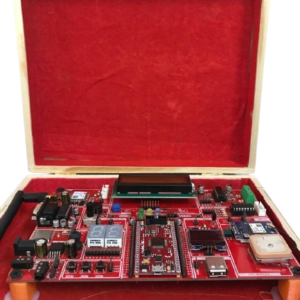
The development kit provides access to a variety of interfaces and modules for practical experimentation:
- Relay
- Stepper Motor
- DC Motor
- Servo Motor
- DHT11 Humidity and Temperature Sensor
- Ultrasonic Sensor
- GSM Module
- MAX232
- LoRa Module
- Heart Rate and Pulse Oximeter Sensor
- MPU-6050 3-Axis Accelerometer and Gyroscope
- Blinking LEDs
- OLED Display
- LCD Display
- RTC Serial Port
- Rotary Encoder
- RS485
- MQ135 Air Quality Sensor
- PIR Sensor
- LAN Module
- NB-IoT
- Buzzer
- Buttons
Embedded Systems and IoT Applications
The Raspberry Pi Pico Development Board can be used for embedded systems training, sensor-based projects, robotics, automation, IoT experiments, motor control, display applications, communication projects, and rapid prototyping. It is also suitable for academic laboratories and practical learning environments where students can gain hands-on experience with programming and hardware interfacing.
The board can be integrated with different sensors and modules to create monitoring systems, automation prototypes, robotics projects, and other microcontroller-based applications. Developers can also use C/C++ and MicroPython according to their project requirements.
Raspberry Pi Pico SDK and Programming
For developers working with C and C++, the official Raspberry Pi Pico SDK provides the headers, libraries, and build system required to create applications for RP-series microcontrollers. The official documentation also provides examples and references for features such as ADC, UART, I2C, PWM, timers, RTC, and other functions.
For more technical information, refer to the official Raspberry Pi Pico SDK documentation.
Required Tools
- Thonny Python
- MicroPython
- C/C++ Development Environment
For other development platforms, explore the Arduino Nano Development Board, ESP32 Development Board, NodeMCU Development Board, and STM32 Blue Pill Development Board from SSG Embedded Solutions.
Reviews
There are no reviews yet.